Challenging The Idea of Gay ‘Exorcisms’

Christianist hate-monger Bryan Fischer, continues to insist that gay exorcisms work.

This really pisses me off on three levels –

First, as a gay/queer/GSRM person, the idea that who and how I love is something that needs to be forcibly driven out of a person is deeply offensive. Many of these ‘exorcisms’ are nothing more than brutal psychological and sometimes physical abuse, couched in a religious framework, and structured to encourage mental disassociation in a way not unlike some forms of CIA brainwashing.

Secondly, as I’ve discussed on NFABS many times before, my own religious/spiritual tradition includes the concepts of spirit/deity possession, and possessory work as part of spiritual practice.

Now obviously my cosmology is not anymore universal or ‘correct’ than Bryan Fischer’s or anyone else’s. But it bothers me to see sexual orientation treated as something external, or even as an independent entity that can be driven out. Even many of the right wing Christian groups that practice gay ‘exorcisms’ aren’t arguing that one’s sexual orientation or gender identity is an external force or consciousness, despite appropriating the trappings of possessory practice in the service of their bigotry.

The vast majority of traditions that incorporate the concept of possessory experience have the idea of something external coming into a person (usually invited), and then being asked or made to leave again after a period of time. This is radically different from an exorcism intended to excise a part of oneself. So based on my own exposure to these sorts of traditions and practices, I find the whole concept ‘gay exorcisms’ angering on a spiritual/religious level as well.

Finally, as a sexuality educator and advocate for healthy, active sex lives for all (save asexual people of course), there is the very real fact that what ‘ex-gay’ practices, including ‘exorcisms,’ are really doing is encouraging people to exorcise their desire.

The reality is that there are virtual no ‘ex-gays’ who’ve changed their sexual orientation (if there are any at all), but there are certainly some people who’ve managed to cut themselves off from their sexual selves (see point one about disassociation and brainwashing). If these programs were bodily castrating LGBT people there’d be swift condemnation from across the nation, and around the globe. But encouraging or forcing people to mentally and emotionally castrate themselves? That gets a pass as religious freedom.

You don’t have to be queer, do possessory work, or be a sexual advocate to be distressed by the idea of gay ‘exorcisms,’ but put all those together and you wind up with a perfect storm of opposition to the practice. 

Hiding to Stay Visible

After spending the past week in fabulous San Francisco CA, I’m winging my way across the Rocky Mountains returning to dreary Portland Maine.  The company I work for, Odyssey Events LLC, just hosted their first West Coast sex & BDSM conference, after a decade of only doing events in Maryland and DC. Making it all happen took months of hard work, but the event was a spectacular success, exceeding the expectations of everyone who had a hand in its planning, and execution.

In addition to being the event’s national talent coordinator, scheduling coordinator, and production assistant, I kept busy through the weekend: teaching three classes, co-leading opening ritual, and acting as a secondary event photographer. 

I should have had an awesome, if busy time, reveling in the realization of a difficult vision. But on top of all of those things, I also spent the entire event desperately working to suppress the symptoms of my Tourette Syndrome.

For those of you who aren’t familiar with the condition, or whose knowledge doesn’t extend past corpolalia (the relatively uncommon “swearing tics” that the media is so very fond of), allow me a brief moment to explain:

Tourette is a neurological condition that causes repeated involuntary movements and sounds, or “tics.” These can include sniffing, grunting, throat clearing, head jerking, facial grimacing, or just about anything else you can imagine. Both motor and vocal tics must be present (or have been within one year) for a diagnosis to be made, and the symptoms wax and wane over time without a great deal of rhyme or reason. Over time, new tics can develop and old tics can fade away. I have a host of symptoms, from the largely unnoticeable, such as painful dystonic back and neck tics, to more obvious tics like head jerking and the barking from whence my website and blog take their names.

Just as symptoms vary from person to person and moment to moment, so does a limited ability to suppress those tics for periods of time. The problem with suppressing is that it often takes a great deal of mental energy, making it difficult to maintain focus on other things. Suppressing like this also typically makes the tics far worse later, once someone has passed the limits of how much they can suppress, or are in a situation where they can stop doing so. In my case, I can manage my vocal tics for short periods of time, but doing so makes my painful back tics worse, tires me out faster, and means that I’m constantly devoting a considerable amount of focus and attention simply on the effort of not vocally ticcing.

Why then make the effort?  Put simply, I hate being invisible.

I often say, and only half in jest, that growing up with Tourette Syndrome taught me how to be a social entity. After all, I’ll point out, it’s hard to be a wallflower when you’re standing in the corner barking like a small terrier.

But in reality, particularly in sexually charged or queer environments, the rather noticeable consequences of my atypical neurological wiring has the effect of rendering me virtually invisible as a person possessed of sexual agency in the minds of the people around me.

This is hardly unique to my experience as a Touretter of course. Many people who present outwardly as having a disability find that they are automatically classified as a non-sexual being in the minds of those around them and even those whom they interact with on a regular basis.  Nor is this phenomena remotely confined to the rather specialized world of kink and BDSM events.

Among gay and queer men, my condition is often seen simply as a burden too far out there to be bothered with as a prospective partner. There is a regrettable stigma in being LGBT in our culture, and in part out of that stigma has grown the pursuit of a nebulous idea of “perfection” in our sexual and romantic partners. As if to say “yes I’m in a same-gender relationship, but wouldn’t you be too if you could have him/her/hir on your arm?”

Equally significant though, the media engines of Gay Inc. have worked hard to present an image of what it means to be LGB(t) in America: attractive, upper middle class, white, monogamous, and most importantly, “normal.” Even if I ticked all those boxes save the last, which I don’t, being perceived as “normal” hasn’t been on the table for me since my tics became significantly noticeable nineteen years ago.

It’s tempting I know, to say that I’m not giving people credit, that given a chance, many people would be happy to engage with me as a sexual and romantic entity despite the Tourette. We want to believe that faced with this sort of situation we’d be guided by our better angels and look past something as simple as some barking or twitching.

But we don’t, and while that’s sad, it’s also very human. As “proof” I can offer this utterly unscientific experiment I ran over the course of a couple of years:

When I remove any mention of the Tourette from my online dating profiles, without making any other fundamental changes, I get responses to messages I send out, and get unsolicited messages in my inbox with some regularity. Put the Tourette back, and the well goes abruptly dry. It doesn’t really matter how vague or specific I get, or even if I take pains to note that I don’t have coprolalia. If I’m out about the Tourette, I get nowhere.

Nor does the strategy of getting to know someone over the web and building a connection before disclosing my condition prove remotely viable. Once the TS is out in the open, potential play or romantic partners disengage to seek out partners whose neurotransmitters fire in a more conventional way.

While rejection always sucks, I vastly prefer the passive rejection of an unreturned note or a note never sent, over building a connection with someone only to have them turn tail and run when they find out about the Tourette. This is why after much experimentation, I settled on leaving the disclosure in place in my social media and dating-site profiles.

As an aside, I’ve found in talking to many of the trans* people in my life that there are some clear parallels to be drawn between my own experience as a Touretter and the trans* experience, especially but not exclusively as it relates to dating and sexual agency. While as a rule most of the trans* people in my life reject the idea of trans* identity as a “medical condition,” and I certainly wouldn’t call being trans* a “disability, one could likely replace “Tourette” and “TS” in the preceding couple of paragraphs with “trans* history/identity” and have a painfully familiar storyline to many people.

Despite all the issues inherent in being seen as a Touretter, suppressing my tics at Surrender was hardly a rousing success as a strategy. With part of my attention perpetually diverted to managing the tics, I found it hard to fully engage with the people around me, and I know that I was a bit off my game during opening ritual and my urethral sounding class if nothing else.

On a related note, while I’ve achieved a satisfying level of professional success in my field, although I certainly have goals and dreams as-yet-unrealized, I have doubts as to whether I could I have gotten where I am now, had my entry into this world not coincided with a combination of a strong waning phase and a couple of years where my primary tics were not as socially intrusive as the barking (which has been an on-again/off-again companion for nearly nineteen years). After all, as I’ve discussed before, my much of my work is fundamentally related to sex work.

But beneath all the issues of dating and career opportunities, closets are not, and have never been places where I feel comfortable. When I did consider pursuing play at Surrender, or even just a deeper intellectual/emotional connection with someone, I found myself hyper conscious of the fact that I was not presenting them with my authentic self.

Speaking only for myself, Tourette Syndrome is part of my fundamental makeup, and without its overarching influence, my life would surely look radically different than it does today. It’s not hyperbole to say that there’s no way to really know me without understanding the TS and how it has and continues to effect who I am and how I move through my life.

I’d love to say that I’m going to resolve to be more open and positive about the Tourette, or that I won’t repeat this exact same pattern come Dark Odyssey Winter Fire in February. But the reality is that I honestly don’t know.

That’s the Siren’s song of the closet after all.  
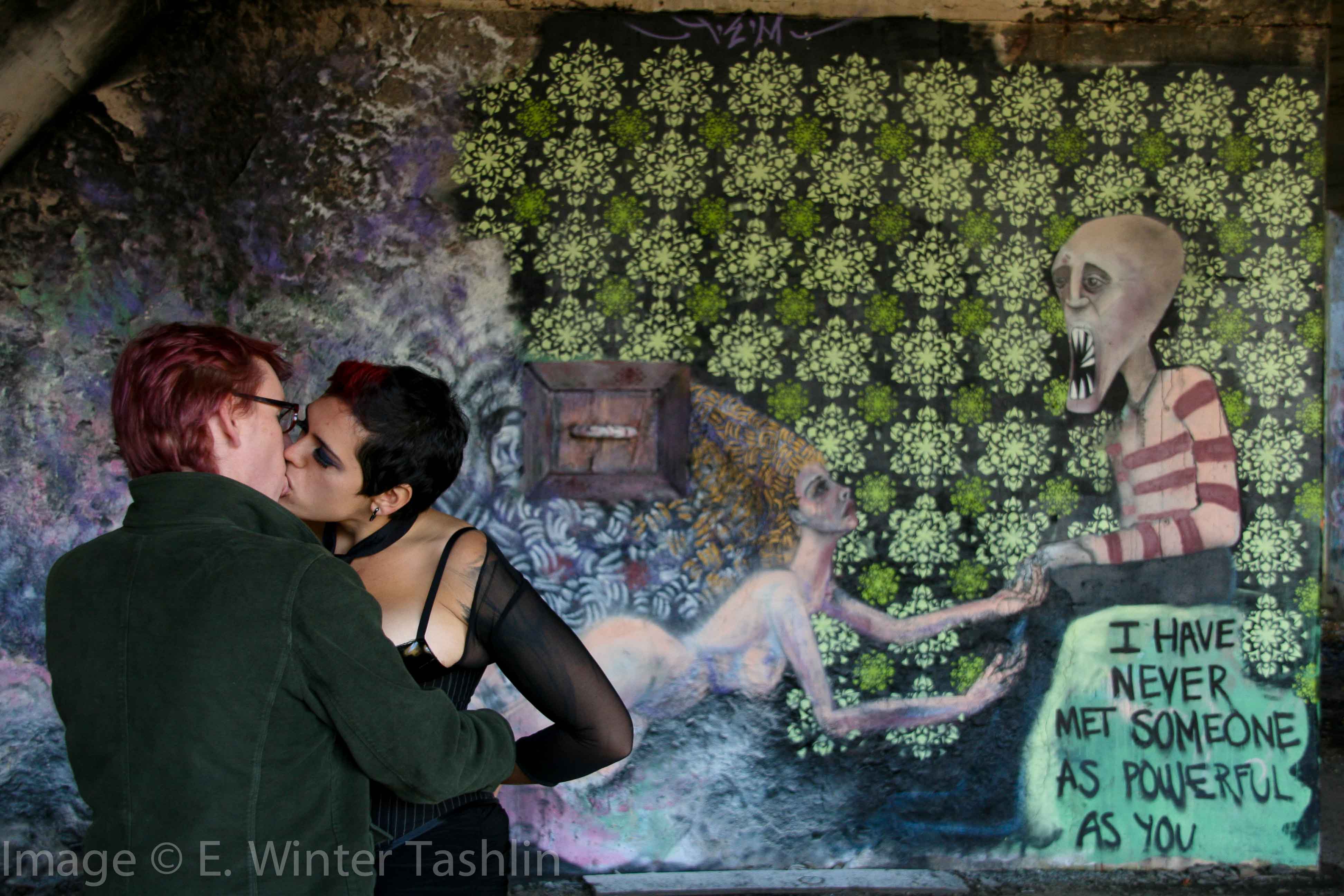
Surrendering to Desire

Note: this is an adaptation and expansion of a post of mine that originally appeared at Bilerico.com on 11/2/12. I’ve made quite a lot of additions that would not have been suitable for the Bilerico audience

The word “Surrender” has been on my mind a lot lately. Firstly I suppose, because it’s the name of Dark Odyssey’s newest event, which is coming up in scarcely a week, so I’ve been saying it an awful lot lately. But also, because “surrender” is something I’ve not been getting enough of in my life lately.

That may seem a bit strange as sentiments go. The whole idea of surrendering is very much not something that we are taught in modern American culture to embrace. Above all, our society embraces and rewards strength, supremacy, and yes: dominance.

Certainly I live a life where those are required assets for survival. Foremost there’s my disability, which is at times highly visible, socially problematic, and requires me to be a strong advocate for myself – often with quite hostile strangers. Then there’s my career as a public speaker, BDSM educator, and as programing coordinator/assistant producer for a BDSM event company. Sexual and relationship dynamics aside, that work requires one to be the embodiment of assertive and in control. As a spirit worker, pagan, and magician, I’m seen by people as a spiritual authority, and while submission to my gods is understood to an extent within the community, there are also expectation of mastery that can seem to many to be absolutely intertwined with an aura of strength and invulnerability. And finally, there’s my work as an LGBT/GSRM advocate, activist, and blogger, where if you show even a moment’s vulnerability, the wolves of intolerance, both from without and within the community, will descend and tear you apart.

In my personal erotic/romantic life, I’ve long identified as a “switch.” That is, someone who enjoys the exploration of dynamics of dominance and/or sadism, as well as those of submission and/or masochism. However, for many years I’ve been unable to find partners and opportunities in which to give free rein to my submissive and masochistic desires.

My aforementioned roles in the BDSM community surely have played a part in those troubles. Of the people who express an erotic or kinky interest in me, the overwhelming majority see me more as a set of skills that they can learn or enjoy, rather than as a holistic person made up of needs and wants. I don’t want to come across as complaining though, it’s a known part of the job I do, and I accept that. More often than not it still leads to mutually enjoyable experiences as well.

The people who have expressed an interest in topping me over the last few years have tended to do so in ways that made me deeply uncomfortable. Several potential play partners have expressed a reluctance to honor my hard limits, with one person saying

come on, I could be the guy who made Wintersong Tashlin ‘red,’ how could I pass that up?

For the record, it’s not hard at all to make me call ‘red,’ (a standard dungeon safe-word), I have a list of clear hard limits, and I am also not nearly as hard a masochist as I am brutal in my sadism. 

But not bottoming for BDSM play has been about far more than not wanting to interfere with people’s perception of my “image,” or the difficulty finding suitable play partners. After all, some of the kinksters I have the most respect for are very public about their own submission, including my boss at Dark Odyssey, and people like fellow BDSM educator Mollena Williams.

What I have come to realize is that for all that I talk frequently in my education work, and deeply believe in. the inherent equality of submissives and dominants, somewhere along the line I internalized those societal messages I mentioned a few paragraphs ago. I fell into the trap of believing that to be “strong” I had to maintain constant control in my mundane, spiritual, and professional life. That it was somehow a mark of failure or weakness to allow myself to let go and surrender to the other side of my nature.

ImageAnd then, last weekend, something remarkable happened. For the first time in years, I permitted myself to relinquish control and indulge the submissive/masochistic side of my desires. I’ve been heavily overworking myself between the push to get everything ready for Dark Odyssey Surrender, an Oct/Nov touring schedule that somehow got insanely full, trying to remain active as an editor and blogger for Bilerico.com, and some complicated issues in my family and spiritual lives.

In a fine hotel room, where I was staying for a conference on gender and sexuality, two truly fabulous men that I’m lucky to have in my life spent a good number of hours beating, pinching, biting, and in other ways tormenting my body, in a way that let my mind be free in a way that I desperately needed. I didn’t go into the situation expecting things to go there, but I was with people who I could trust, and to be honest, I simply didn’t have the emotional resources in that time and space to be a good top. I needed to not be “on,” to be vulnerable, which isn’t something I feel I can be with anyone in my life right now (the topic for another post I suppose).

Of course now is the point where I suppose that I need to specify that yes there were safewords between us, and in the few occasions where I needed to use my “slow down” command it was instantly respected. Likewise, when I said that I had legitimately had enough, the scene ended.

But while it lasted, I was totally consumed with both the sensations in my body, and the consensual illusion of having my life under someone else’s control for a while, yet having that person be someone who didn’t want anything from me, unlike the Lady, Var, or the other gods and spirits I work with in a submissive context.

I could totally forget about planning a huge event in a new city, being a professional BDSM educator, my spirit work, or even the convoluted and anxiety-inducing twists and turns of the 2012 election season. It was glorious, intimate, and amazingly restful, even if parts of my body are still sore nearly a week later. Given how stressful my life has been of late, it’s not hyperbole to say that this scene happened right when I needed it to, in order keep going without a serious breakdown.

Now, obviously BDSM is not for everyone! That I personally found deep meaning in the experience I’ve described doesn’t mean that I think getting consensually beaten is a universal cure-all for the pressures of our lives. But, in a roundabout way, it is.

I believe that we all need to find our “thing,” some part of ourselves that we can surrender to for a while. Maybe it’s being beaten hard by two hot Boston queer boys. But then again, maybe it’s a hobby, a form of entertainment, a deeply held desire to try something different – perhaps even something out of character. It could be something you think you should have outgrown, or something you feel too young for. You could be held back by the pressing needs of your life, fear, or concerns over how people might react, or something else entirely.

Whatever it is, I encourage you to find and embrace that part of yourself. Surrender to your need to escape the everyday realities of your existence, and let yourself go for a short while. An important way to respect yourself is by acknowledging and respecting all your needs, even those that make you a bit uncomfortable.

We can’t be “on” all the time, and if we’re going to be effective when we are, we have to have the down periods too. That’s the only way to keep fighting on in whatever struggles and roles your life is throwing at you.

Eloquently put, and Madwoman cuts right to the heart of why we’ll almost certainly leave Maine if SSM is defeated there. I’d prefer to live even someplace where our rights aren’t guaranteed over someplace where my fellow citizens actively voted to deny me them. (note: I was not a Maine resident during the previous SSM fight in ’09)

Madwoman with a Laptop's avatarThe Madwoman with a Laptop

My humanity is up by nine points in Turtle Country, according to the latest Washington Post poll on the referendum that would extend the right of civil marriage to same-sex couples.  The poll of likely voters shows that 52% intend to vote yes on Question 6, while 43% say they don’t have a homophobic bone in their bodies but are pretty sure the Lord God Almighty thinks that Edith Windsor should have had to pay $363,053 in federal estate tax after her partner of 44 years, Thea Spyer, died in 2009. Wow, who knew the Lord was such a micromanager?

My humanity is also leading in Washington state, by the way, and doing well in Maine. Things are little shakier in Minnesota, but it’s possible my humanity will prevail even there, depending on turnout and how the undecideds go. No lead is comfortable, of course, because the…

View original post 1,015 more words

For a lot of complex reasons, my own restoration has been more off than on, but stories like this help keep me engaged and committed to finishing eventually.

TLCHamster's avatarLizard Dick

Mort  Turtleneck

Originally written February, 2012

Today I’m celebrating sixth months of foreskin restoration, if you want to call a passing thought a celebration. But yeah, 6 months into the big stretch and I’m happy to report things are going well.

In a bitter-sweet sort of way, I’ve achieved semi-consistent accumulation of smegma resulting in the head of my penis becoming smoother and having a healthier colour than before.

Sex is more satisfying in ways I didn’t anticipate. As I said before, oral sex, for me, was a ho-hum affair. I appreciated the gesture, but the excitement really came from the act of it all and not so much the actual skin on skin sensations. I had read how much more satisfying things became after shedding some of that calloused skin, which it has, but what really surprised me was what I was feeling further down the shaft past the head.

It…

View original post 411 more words